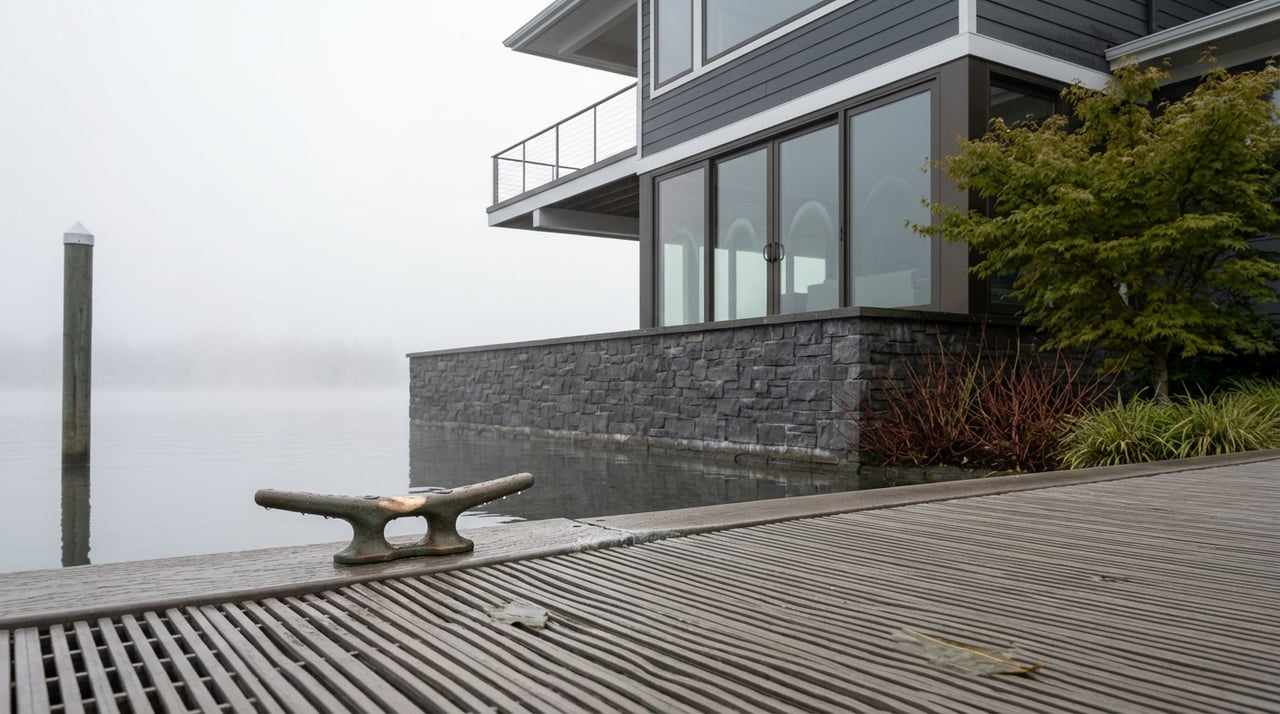
If you own a home on Lake Washington in Kirkland and you are thinking about listing this year, here is a question worth answering before the sign goes in the yard: does the dock behind your house sit on land you actually own, or on land the State of Washington owns and merely lets you use? Most sellers assume the answer is obvious. It is not, and the gap between those two answers can turn a straightforward waterfront sale into a closing that slips by months, not days.
This is not a story about dock condition. Weathered decking, a boat lift that needs servicing, a pile that has seen better winters, all of that shows up on an inspection and gets negotiated like any other repair item. The friction that actually stalls Lake Washington closings in Moss Bay, Houghton, Juanita Bay, and Yarrow Point lives somewhere less visible: in whether the right to have a structure sitting in the water at all is something you can hand to a buyer the same day you hand over the keys.
Land Ownership Stops at the Waterline
Washington's Shoreline Management Act treats the water and the land beneath it differently from the lot your house sits on. In Kirkland, the zoning code that implements the city's Shoreline Master Program designates the waters of Lake Washington and their associated shorelands as a "shoreline of statewide significance," and defines the Ordinary High Water Mark for the lake at a specific elevation, 18.5 feet under the NAVD 88 datum. That mark is the legal line where private upland ownership ends and a different set of rules begins.
Below that line, much of Lake Washington's bed is state-owned aquatic land, managed by the Washington Department of Natural Resources. DNR describes its own authorizations as legal contracts that convey specific property rights to a user in exchange for rent, which is a different arrangement than owning the ground your house sits on outright. If your dock, buoy, or boat lift extends over or is anchored in that state-owned area, what you actually hold is not always a piece of your deed. It can be a leasehold interest with the state, running alongside the sale rather than automatically inside it.
The Six-to-Twelve-Month Problem Hiding Inside a Thirty-Day Closing
Here is where the timeline breaks. A typical residential closing in the Puget Sound region moves in weeks. A DNR aquatic land lease does not move on that clock at all. Legal guidance on Washington aquatic land leases notes that the lease process runs six to twelve months from the date DNR receives a complete application, and that while the law allows an aquatic lands lease to transfer to a new owner, the specific terms of the existing lease can add requirements of its own, including state approval of the transfer itself.
Read that against a normal purchase and sale agreement and the mismatch is obvious. A buyer signs expecting to inherit the dock the same afternoon they inherit the house. If the existing lease requires DNR sign-off to transfer, or if no lease was ever put in place for a structure that legally needed one, that piece of the transaction is not something a title company can resolve in the standard three or four week window before closing. It is a separate regulatory process running on state government time, not escrow time.
This is the actual risk in a Kirkland waterfront sale. Not that the dock looks tired, but that nobody confirmed early on whether the right to keep it there transfers cleanly, and how long confirming that might take.
Kirkland Layers Its Own Rules on Top of the State's
Kirkland administers its own Shoreline Master Program rather than deferring entirely to the state, which means local specifics matter alongside the DNR question. City planning documents note that any pier or dock exceeding 150 feet in length requires a shoreline variance in Kirkland, and that the city shares an Administrative Approval Option with Lake Forest Park, Mercer Island, Bellevue, and Hunts Point, a streamlined path other Eastside lake cities use for the same category of review.
Dollar thresholds matter too, particularly for anyone considering dock repairs before listing. Washington's Department of Ecology sets the general substantial development threshold at $8,504, a figure that has been in effect since July 1, 2022 and will not be adjusted again until July 1, 2027. But residential dock construction gets its own, higher exemption: as of August 5, 2023, a dock built to replace an existing one, at equal or lesser square footage, in a jurisdiction with an updated shoreline master program, can be exempt from a substantial development permit up to $28,000 in fair market value.
| Threshold | Applies to | Amount | Effective |
|---|---|---|---|
| General substantial development | Most shoreline construction | $8,504 | July 1, 2022, next adjustment July 1, 2027 |
| Residential dock replacement exemption | In-kind dock rebuilds, equal or lesser footprint | Up to $28,000 | August 5, 2023 |
That gap between $8,504 and $28,000 is easy to misread as a green light to replace a dock quietly before listing. It only applies to in-kind replacement in a city with an updated master program, which Kirkland has. Anything larger, or any change to footprint, length, or use, likely needs its own review under KZC Chapter 83 in addition to whatever state process applies.
King County offers a useful reference point for how long that kind of review actually takes in this region. The county states that shoreline permits require a pre-application meeting before an application can even be filed, and that processing runs 120 days once submitted. That is the county's own stated timeline for a permit review, not a lease, and it still runs longer than most listing-to-closing calendars.
Where This Meets the Seller Disclosure Form
Washington requires nearly every residential seller to complete a Seller Disclosure Statement, known in the trade as Form 17, under RCW 64.06. The statute's structure creates a specific timing risk for waterfront sellers: if a buyer receives the disclosure after mutual acceptance rather than before, they get a three business day window to rescind the entire agreement, no explanation required.
Now layer the dock question on top of that. If a seller has not confirmed whether a DNR lease exists, whether it is current, or whether prior dock work happened without the required permit, that uncertainty tends to surface exactly when a buyer's title company or attorney starts asking questions, which is often after mutual acceptance, inside that same rescission window. A buyer who discovers mid-escrow that the dock's legal status is unresolved has both a reason to walk and a clean, short deadline to do it. The seller who found out first, and who priced and marketed the home with that answer already in hand, does not.
What to Confirm Before You List, Not After You Go Pending
The fix here is sequencing, not paperwork for its own sake. Before a Kirkland waterfront listing goes live, a seller benefits from knowing:
- Whether any part of the dock, buoy, or lift sits below the 18.5 foot OHWM elevation on state-owned aquatic land, which determines whether a DNR lease applies at all
- If a lease exists, its current status, its transfer terms, and whether DNR approval is required to move it to a new owner
- Whether any dock work performed since purchase exceeded the $8,504 general threshold or the $28,000 in-kind replacement exemption, which would have triggered a Kirkland shoreline permit
- Whether the dock's length stays under the 150 foot threshold that triggers a shoreline variance under Kirkland's code
- Whether any of the above needs to be addressed in the Form 17 disclosure before it reaches a buyer, rather than during their due diligence period
None of this is a reason to delay a sale that is otherwise ready to go to market. It is a reason to start the confirmation process in parallel with photography and pricing, not after an offer arrives.
Frequently Asked Questions
Does every waterfront home in Kirkland have a dock lease question to resolve? No. Some docks sit entirely on private upland property or were established before current review requirements existed. The point is confirming which situation applies to your specific parcel rather than assuming.
What if the dock was already there when I bought the house? A structure predating your ownership does not resolve the underlying question of whether it sits on state-owned aquatic land or whether a lease was ever properly put in place. It is worth confirming rather than assuming the prior owner handled it.
How much lead time should a seller build in? If a DNR lease needs to be established or transferred with state approval, plan for months rather than weeks. Starting that conversation before listing, rather than after an accepted offer, is what keeps a strong waterfront listing from stalling at the one stage buyers cannot see coming.
Selling a Lake Washington home carries enough moving pieces without a dock's legal status becoming one of them late in the process. Sound Real Estate Services works with Kirkland waterfront owners to sort out exactly this kind of question before a home goes to market. If you are considering a sale in Moss Bay, Houghton, Juanita Bay, or Yarrow Point, schedule a consultation and get the dock question answered first.